
Water leak Detection
There primarily are two sets of pipes on your property.
The fresh water pipes
This is the pipe network that brings water onto your property from the municipality line via the metre which is typically outside your property next to the wall. The pipes will run through the yard into the house taking water to all the points including all garden taps, sinks, toilets, bathroom basins, showers, bathtubs and geysers.
Wastewater pipes
This is the pipe network from where water would have been used, these include the pipes that take used water from the bathtubs, sinks, basins, showers and toilets to the main waste pipe that will take it out of your property to the main sewer line.
Water leaks can occur on any of the two piping networks.
How do you know you have a leak on your property?
- Water bills.
Monitor your municipal bills every month to check for consistency of your billing. If you have a sudden spike in one month then you most probably are losing water somewhere, most probably in places you cannot even see. It’s important to compare usage over a couple of months to establish a pattern.
- Water Metre.
Close all the water outlets in and outside the house then go and inspect your metre to check whether it stops running when water points have been closed. If your metre still moves when all the outlets are closed, then you are most probably losing water somewhere. You need to take your time observing, some of the leaks are very slow and the metre will be moving ever so slightly.
- Sound of running water.
Hearing a whistling-like sound continuously either in your home or in your yard is often a sign that there is a leak somewhere on the pressure pipes. You need to get leak detection plumbers to come check it out.
- Running Toilets.
Amongst the points where you are likely to have leaks are your toilets, the leaks occur between the tank on top where the water that you flush is stored and the water bowl at the bottom. There is a rubber stopper at the bottom of the tank, it gets damaged over time which will result in water running continuously. The mechanism which is based on the floating ball automatically when full will stop working resulting in water continuously running into the tank which could cost you dearly as you would be losing water continuously throughout.
Please make a point of checking your toilets for leaks frequently. Some of the toilet leaks are very slow and difficult to see with the naked eye, you can use food dye, open the tank on top, put a few drops of the dye, and wait for about 10 min without flushing. Should the colour at the top start to emerge in the bowl at the bottom, you have a toilet leak. You will need to fix it.
- Outside water points.
Check all water points for leaks outside the house and in your yard, this includes garden taps. Make it a point to check all the water points from time to time, remember although it may be drops that the taps will be releasing at a time, it will be 24/7 which could be a sizeable amount of water over time.
- Check around your yard.
Look around your garden for consistency in the lawn, you may have a portion on your lawn that is greener than others. This may well be a result of that portion receiving more water than the rest of the garden. There will most probably be a leak underneath that path. Sometimes you will even see some water which would have risen to the surface.
- Check around the house.
Inspect all the areas in the interiors of the house, the walls, the ceiling, and the cupboards for moisture or moulds or paint peeling off or strange smells. Some of the leaks come from wastewater pipes, they will still cause damage, nevertheless.
- Waste pipe from the Geyser.
Check the waste pipe that comes out of the roof typically between the top of the wall of the house and the roofing. Any leaks on and around the geyser should be directed to the drip tray, which will be connected to a waste pipe to take the water out of the roof. If your geyser was installed per the plumbing standards, it should have a drip tray and a wastewater pipe out of wherever the geyser is located.
How do our professional leak-detecting plumbers find the leaks?
We use a combination of tracing gas and sonic and acoustic equipment to pinpoint sounds from a distance. When it comes to leaks, it is advisable to use specialised leak detection plumbers. They will pinpoint the leak with accuracy and have the expertise to break whatever is on top of the pipe to get to the exact location and fix the leak without causing unnecessary damage. DIY leak detection may seem like a cost-effective solution but often leads to more problems than it solves.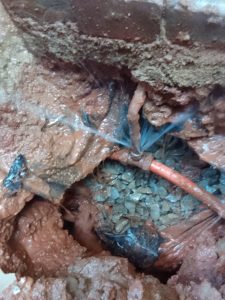
Leak detection comes in two parts, finding the leak and fixing the leak which will be quoted separately.
Our experience over the years is that outside the house, most leaks will either be under concrete or paving, which is why they are difficult to locate.
If you see any of the signs mentioned above, you will probably have a leak somewhere, which will cost you a lot of money if you do not deal with it quickly. For assistance with leak detection and the fix, contact Superquick Plumbing and Electrical. You can visit the website www.superkwik.co.za, email info@superkwik.co.za, or phone/WhatsApp 0734247271 to schedule an appointment.